Your one page AI policy.
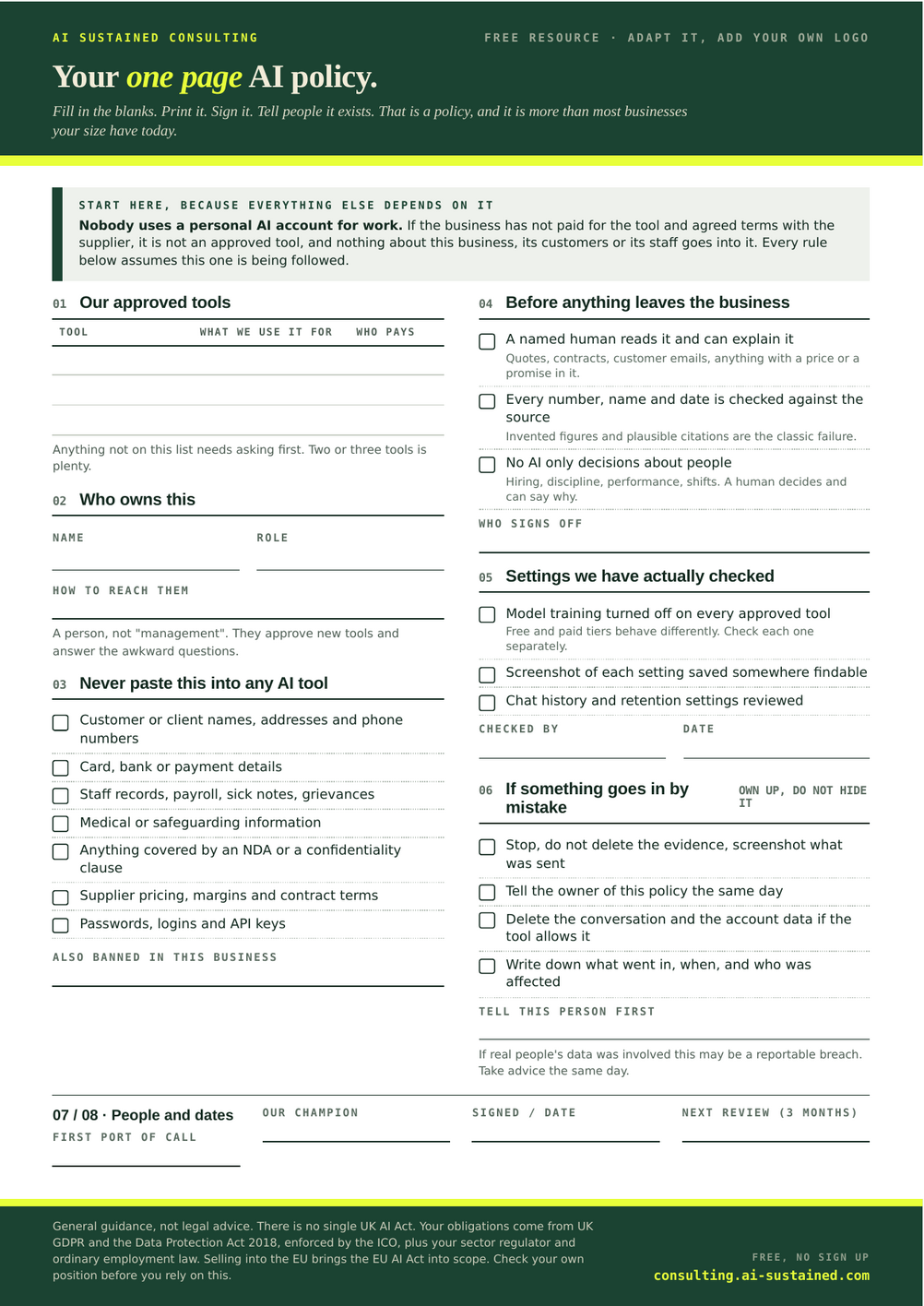
Fill in the blanks and you have a policy. Eight sections, most of them already written, and a signature line at the bottom.
Almost nobody turning over between a quarter of a million and a million pounds has a written AI rule. Not because they do not care. Because every template online is fourteen pages of somebody else's risk appetite, written for a company with a legal department.
This is one page. You fill in your tools, your names and your dates. The rest is already written. Print it, sign it, put it where people can see it, and you are ahead of most of your competitors.
What is on it
- Your approved tools, who uses them and who pays
- One named owner, because "management" is not a person
- The never paste list, printed in full
- Sign off before anything with a price or a promise leaves the business
- The settings you should have already checked, and a box to say you did
- What to do when somebody gets it wrong, without a witch hunt
- A signature and a review date, three months out
The rule everything else rests on
At the top of the sheet, before anything else: nothing about the business, its customers or its staff goes into an AI account the business has not paid for and agreed terms on. A personal account is not a controlled tool. Every other rule assumes that one is being followed.
Take the Word version, put your own logo on it, delete the bits that do not apply. That is what it is for.
FREE · NO SIGN UP · NO EMAIL ADDRESS
If the free version raises more questions than it answers, that is the point.
The paid work is an AI audit: a fortnight looking at what your business actually does, what is already being used without anyone deciding it, and what two or three changes are worth doing first. You get a written pack and a conversation, not a subscription.
SEE WHAT A FINISHED AUDIT LOOKS LIKE